
If you checked your website traffic this week and something felt off — rankings dropped, phone inquiries slowed down, or your Google position changed — there’s a very specific reason for it.
Google launched its March 2026 Core Update on March 27, 2026. It is still actively rolling out as of today, and it could take up to two more weeks to fully settle. This is the first major core update of 2026, and it came right after Google also pushed a spam update on March 24-25. Two big changes in the same week. For business owners in Hyderabad who depend on Google for leads, this matters.
Let me explain what happened, what it means for your business, and what you should (and shouldn’t) do right now.
What Is a Google Core Update?
Google makes small changes to its search algorithm hundreds of times every year. Most of these go unnoticed. But a few times a year, Google makes a large, broad change to the way it ranks websites — and that’s called a core update.
These core updates don’t target any specific website or industry. They change how Google evaluates and ranks content across the entire web. Some websites go up. Some go down. And many stay the same.
The March 2026 Core Update is described by Google as: “a regular update designed to better surface relevant, satisfying content for searchers from all types of sites.”
In plain language — Google recalibrated what it considers genuinely useful content, and websites that were ranking based on tricks, thin content, or outdated SEO tactics are now being pushed down. Websites with real, helpful, well-structured content are moving up.
What Happened in the Last Week — A Timeline
Here’s a quick look at what Google did in the last 10 days:
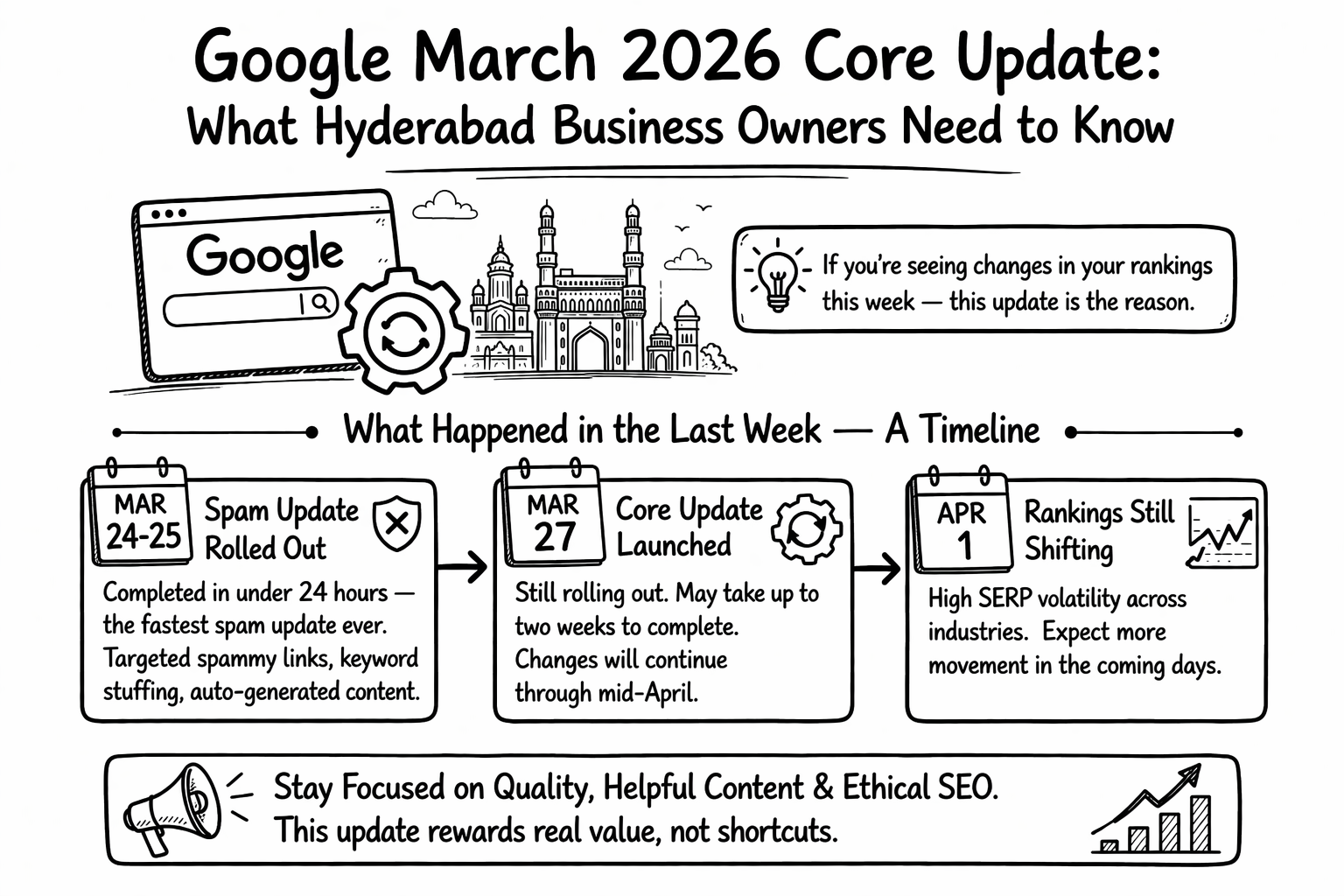
March 24-25: Google rolled out the March 2026 Spam Update. It completed in under 24 hours — the fastest spam update in Google’s recorded history. This targeted websites using manipulative link building, keyword stuffing, auto-generated pages, and other spammy practices.
March 27: Google launched the March 2026 Core Update. This is still rolling out and is expected to take up to two weeks to complete. This means ranking changes will continue through mid-April.
April 1: Rankings across industries are still shifting. Many SEO professionals are reporting some of the highest SERP volatility of 2026 so far.
If you’re seeing changes in your rankings this week — this update is the reason.
What Did Google Actually Change?
Google hasn’t published a detailed breakdown of every signal it updated. They rarely do. But based on what SEO experts are observing across thousands of websites, here’s what the March 2026 Core Update appears to reward and punish:
What Got Rewarded
Genuine expertise shown through content. Websites written by people who clearly know their subject — not just articles that mention a keyword many times — are performing better. If your content demonstrates real experience and specific knowledge, this update likely helped you.
Strong E-E-A-T signals. E-E-A-T stands for Experience, Expertise, Authoritativeness, and Trustworthiness. Websites that show who is behind the content, include real client results, display certifications, and link to credible sources are ranking better after this update.
Helpful, well-structured pages. Pages that clearly answer what a user is looking for — with proper headings, clear answers, FAQs, and good readability — are seeing positive movement.
Local relevance. There is strong evidence that this update improved Google’s ability to understand local intent. For searches like “digital marketing freelancer in Hyderabad” or “SEO expert near me,” Google is better at matching users with genuinely local, relevant providers.
What Got Punished
Thin content. Pages with very few words, generic information, or content that doesn’t actually help the reader are dropping. This includes pages that are essentially a list of services with no real explanation.
AI-generated content without human editing. Google is not penalizing AI content specifically. But it is penalizing low-quality, generic content — and a lot of unedited AI-generated content falls into that category.
Spammy link practices. Combined with the spam update, websites using low-quality backlinks from unrelated directories or paid link farms have taken a hit.
Duplicate and copied content. Pages that repeat the same information from other websites without adding anything original are being pushed down.
Should You Panic If Your Rankings Dropped?
No. And here’s why.
First, the update is still rolling out. Rankings are shifting daily. A drop today might partially recover by next week as the algorithm settles. Google itself recommends waiting at least one full week after the rollout completes before drawing any conclusions.
Second, a drop during a core update does not mean you violated any rule or received a penalty. It simply means Google recalibrated its standards and your current content doesn’t fully meet the new benchmark. That’s fixable.
Third, trying to make rapid changes to your website during an active rollout is not a good idea. You won’t be able to tell what’s working and what isn’t while the algorithm is still adjusting.
The right approach: monitor your rankings and traffic in Google Search Console, note which pages dropped and by how much, and then make a plan to improve those pages once the update settles — which should be around mid-April.
What This Means for Hyderabad Businesses Specifically
If you run a small or medium business in Hyderabad and you rely on Google for customer inquiries, this update is a signal about the direction things are heading — not just now, but for the next few years.
Google is getting better and better at understanding whether a website is genuinely useful or just trying to game search rankings. Businesses that invest in real, helpful content — content that actually answers customer questions, shows real expertise, and builds trust — will continue to grow their online visibility.
Businesses that rely on shortcuts, outdated tactics, or thin pages with minimal information will find it increasingly difficult to maintain their rankings as each update comes.
The practical steps that protect your website from future updates are the same ones that help you right now:
Improve your content depth. Every service page on your website should genuinely explain what you do, who it’s for, what results you deliver, and why a customer should choose you. Not just a few bullet points.
Show who you are. Add a real photo, your name, your experience, and your credentials to your website. Google uses these signals to understand whether a real expert is behind the content.
Collect and display client testimonials. Real reviews with real names build trust for both Google and your website visitors.
Fix technical issues. Page speed, mobile usability, and Core Web Vitals still matter. A slow website that works poorly on mobile is at a disadvantage regardless of content quality.
Build local relevance. If you serve customers in Hyderabad, your website should mention the specific areas you cover — Kukatpally, Gachibowli, Madhapur, Hitech City, Banjara Hills — and the types of businesses you work with locally.
What Should You Do This Week?
Here’s an honest, practical action plan for the next two weeks while the update is still rolling out:
This week: Open Google Search Console and check your performance data. Look at which pages gained or lost clicks and impressions since March 27. Make a note — don’t make major changes yet.
After mid-April: Once the update finishes, review your pages that dropped. Ask honestly — is this page genuinely helpful? Does it show expertise? Is the content thin or outdated? Then improve those pages.
Going forward: Build a content habit. One solid, helpful blog post per month. Regular updates to your service pages. A consistent focus on showing real expertise rather than just targeting keywords.
If you’re unsure how to diagnose what happened to your website after this update, or if you want a clear picture of what needs to improve, a proper SEO audit is the best starting point. It removes the guesswork and gives you a clear list of exactly what to fix.
My Perspective as a Digital Marketing Freelancer in Hyderabad
I’ve been watching this update closely since it started rolling out on March 27. My honest view is that it’s a good development for businesses that are doing things the right way.
For years, some websites have ranked in Hyderabad’s local search results not because they’re the best option for customers, but because they figured out how to game the algorithm. This update moves things closer to what Google has always wanted — genuinely useful local businesses appearing at the top.
If you’ve been investing in real content, real client relationships, and honest SEO practices, this update should work in your favour over the next few weeks as it fully settles.
If your rankings dropped and you’re not sure why, I’m happy to take a look. As a digital marketing freelancer in Hyderabad, I work with local businesses across the city to build search visibility that holds up through algorithm changes — not just temporarily.
You can also explore my local SEO services for Hyderabad businesses or see what I’ve delivered for past clients to understand how I work before reaching out.
Frequently Asked Questions
When will the March 2026 Core Update finish rolling out?
Google said the rollout may take up to two weeks from March 27. Full stabilization is expected around mid-April 2026.
My rankings dropped — will they come back?
Possibly. Some ranking changes during a rollout reverse naturally as the update settles. If the drop is due to genuine content quality issues, recovery typically happens at the next major core update, expected around June or July 2026.
Does this update affect local businesses in Hyderabad?
Yes. Local search is included in every core update. The March 2026 update appears to give more weight to genuine local relevance and E-E-A-T signals, which directly affects how local service businesses rank in Hyderabad and other Indian cities.
Should I change my website right now?
Google recommends waiting until at least one week after the rollout completes before analyzing performance or making major changes. Rapid changes during an active update make it harder to understand what’s actually working.
How is this different from the spam update?
The spam update (March 24-25) targeted websites using manipulative or deceptive practices. The core update (March 27) is a broader recalibration of how Google evaluates content quality across the entire web. Both can cause ranking changes, but for different reasons.
How do I know if this update affected my website?
Open Google Search Console and compare your clicks and impressions from March 27 onwards against the previous period. Any significant drop in that time window is likely connected to this update.
Comments (0)